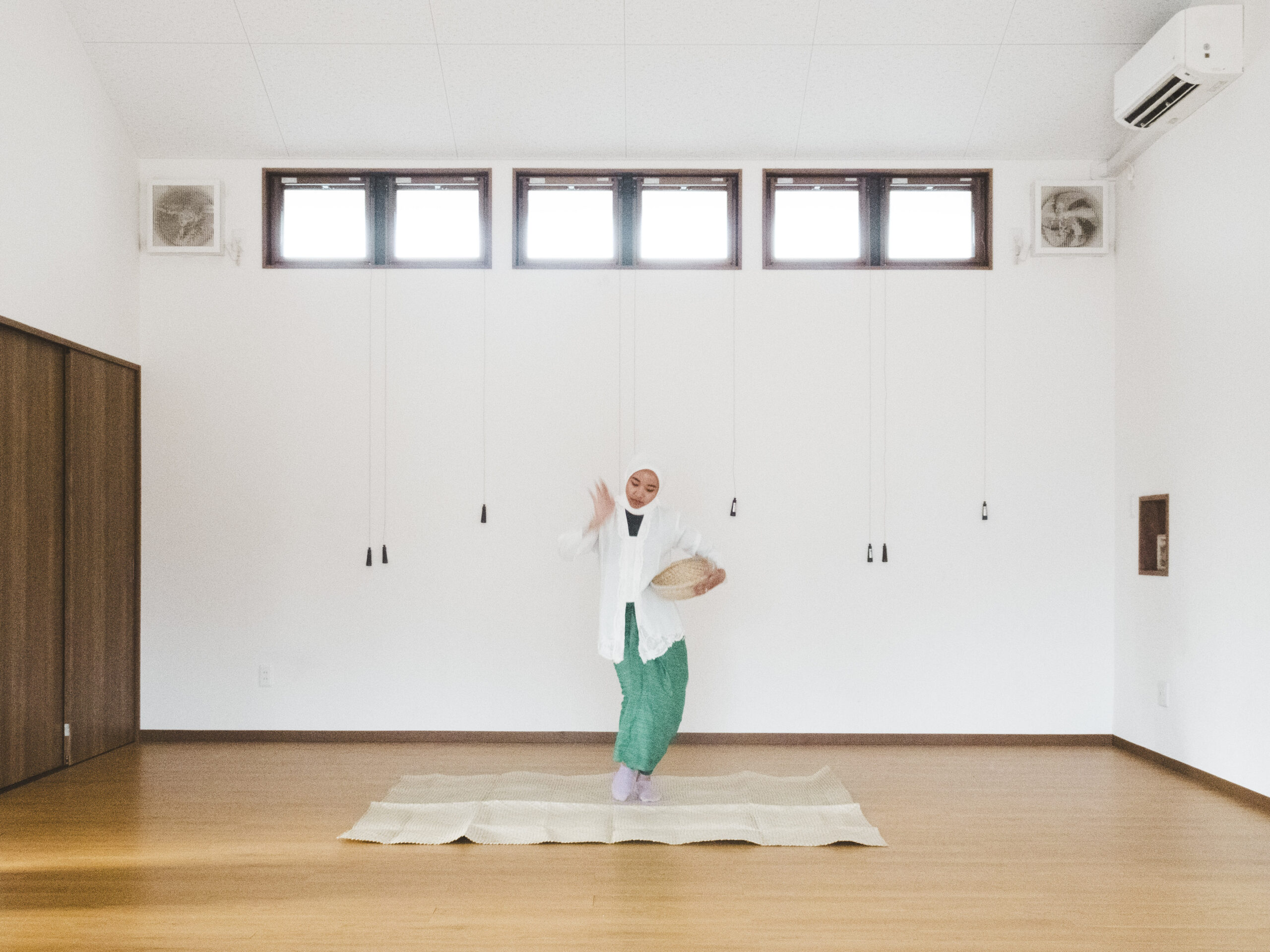
『ゲンジェル・ゲンジェル』制作ノート このパフォーマンスは、父と私が並んで座り、亡くなった祖母に思いを巡らせながら語り合う場面から始まる。「私がRemon舞踊を踊っていたのは、母も踊ることが好きだったからなんだ。」
父はそう振り返った。Remongは東ジャワに伝わる伝統舞踊である。
ゲンジェルとは食用になる水生植物であり、日本軍占領下のインドネシア(1942〜1945年)において重要な食料のひとつとなった。その後、この植物は「ゲンジェル・ゲンジェル」という歌の着想源となり、曲はインドネシア全土で広く知られるようになった。しかし1965年の事件以降、この歌はインドネシア共産党(PKI)と結び付けられ、その後の反共産主義的な迫害のなかで排除されることとなった。
このパフォーマンスは、単に禁じられた踊りを再現しようとするものではない。それは、祖母という存在、彼女が生きていた文化的世界、そして断片的な語りによって受け継がれてきた家族の歴史を記憶するための試みである。
– – – – – – – – – – – – – – – – – – – – – – –
This performance begins with a conversation between my father and me as we sat together, reminiscing about my late grandmother. “I used to perform Remong dance, a traditional dance from East Java, because my mother loved dancing too,” my father recalled.
He also remembered that my grandmother used to dance to Genjer-genjer, a popular Indonesian song originating from Banyuwangi, East Java. My father suggested that she might have been involved in Gerwani (Indonesian Women’s Movement), an organisation that became a target of persecution following the political events of 1965. After the marriage of my grandmother and grandfather, they went back to my grandmother’s house and the house was marked by the authorities, putting the family in danger. As my father remembers it, my grandfather, who was a member of the Indonesian National Armed Forces (TNI), later marked the house as a military residence to protect the family.
Genjer is an edible aquatic plant that became an important food source during the Japanese occupation of Indonesia (1942–1945). It later inspired the song Genjer-genjer, which became widely known across Indonesia. Following the events of 1965, the song became associated with the PKI and was suppressed amid the anti-communist persecution that followed.
This performance is not simply an attempt to reconstruct a forbidden dance. It is a way of remembering my grandmother, the cultural world she belonged to, and a family history passed down through fragments of conversation. I do not know exactly how she danced. What remains is a story told by my father, and my attempt to give that memory a physical presence through my own body.